
I’ll be speaking with tenth graders at two Northeast Ohio high schools tomorrow (Shaker Heights High and Cleveland’s Martin Luther King, Jr. High School) regarding the dangers of distracted driving and how this relates to car accidents. This is part of the EndDD campaign supported by AAJ, Joel Feldman’s www.endDD.org, and the Cleveland Academy of Trial Attorneys. I wanted to put out a few of the scary facts behind the need for these types of presentations.
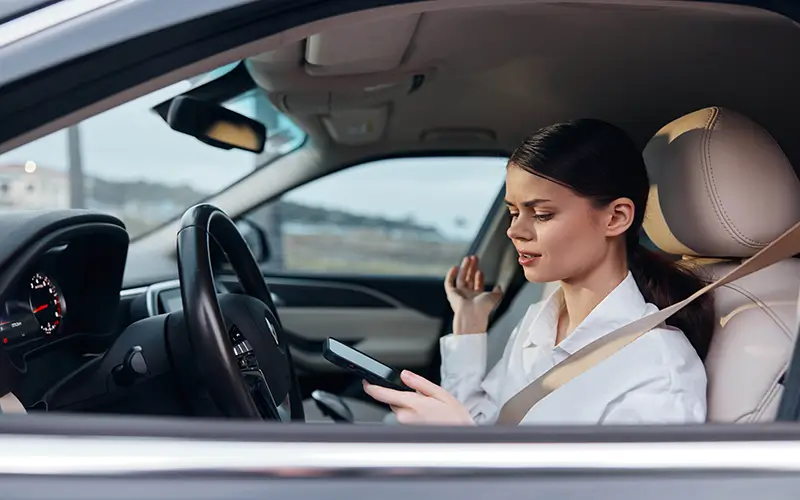
Whether it is eating and drinking, applying makeup, programming a GPS, playing with the radio, or, most notably, reading or sending text messages, distractions kill. In the 4 seconds it takes on average to send a text, a car traveling at 50 mph travels the entire length of one football field. Try to imagine yourself driving blindfolded, across the entire length of a football field, at 50 miles per hour. Even on an empty field, you’d understand immediately this is potentially deadly. Now try it on a roadway, with traffic and pedestrians.
Despite all of the warnings that have come out—April is Distracted Driving Month—drivers spend about 11 percent of the time looking at something other than the road in front of them, according to a study done by The New England Journal of Medicine. The truth is that these activities cause manual, visual, and cognitive distractions. Texting and driving is an activity that requires a significant amount of attention in all three categories, therefore making it the most dangerous of all of the distractions.
According to www.EndDD.org:
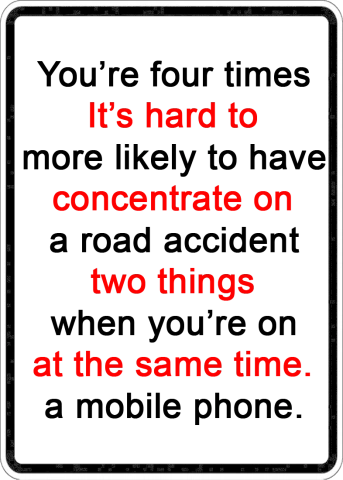
Talking on a cell phone while driving is as risky as driving with a blood alcohol level of 0.08. A person who is drunk driving with a 0.08 blood alcohol level is 4 times more likely to be involved in an accident. From that standpoint, talking on a cell phone is about the same as driving drunk, meaning when you are text messaging, the crash risk goes up to 8 times.
To put that in perspective for parents, consider that young drivers are at the greatest risk for distracted driving—the NHTSA says that in 2009, some 16 percent of teen drivers involved in a fatal crash were reported to have been distracted. As reported by EndDD, texting is even worse:
Researcher David Strayer of the University of Utah found that talking on a cell phone quadruples your risk of an accident, about the same as if you were driving drunk. That risk doubles again, to eight times normal, if you are texting.
It isn’t just a teenager issue, though. A 2012 study showed that teenagers whose parents show distracted driving behavior are more than twice as likely to drive distracted themselves. Check out this new PSA:
Do you think you are a safe driver, or a lucky one? We encourage everyone to step up and put an end to distracted driving; it can change your life and countless others.
Studies: